Why diamond grinding beats acid etching every time
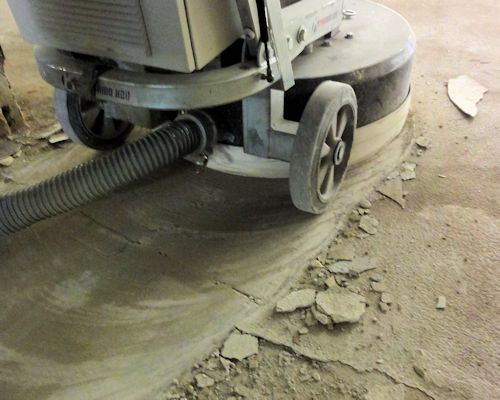
The single biggest factor in how long an epoxy floor lasts is not the resin — it's the surface prep. A premium 100% solids system applied over poorly prepared concrete will fail in years. A budget water-borne epoxy over properly ground concrete will easily outlive it.
What surface preparation actually does
Smooth, hand-trowelled concrete has a closed surface — the cement paste forms a glassy layer called laitance that has weak adhesion to anything you put on top of it. Surface preparation removes that laitance and "opens" the concrete so the primer can grip the dense aggregate underneath.
There are two common methods:
- Acid etching. Apply diluted hydrochloric or muriatic acid, scrub, rinse, neutralise, let dry. Cheap. DIY-friendly. The result is a slightly rougher surface — but mostly because it has dissolved a thin layer, not because it has opened the matrix.
- Diamond grinding. A heavy machine fitted with diamond-impregnated discs mechanically abrades the top 1–2 mm of concrete. Opens the matrix properly. Removes oil, paint, and existing coatings as a bonus.
The numbers
The International Concrete Repair Institute defines surface profiles from CSP-1 (smoothest) to CSP-9 (roughest). Acid etching achieves around CSP-1 to CSP-2. Diamond grinding achieves CSP-3 to CSP-5. Most epoxy manufacturers specify CSP-3 minimum for adhesion — you simply cannot get there with acid.
The practical consequence: an acid-etched floor often peels within 1–3 years, especially under hot tyres, oil drips, or moisture from below. A diamond-ground floor with the same coating regularly lasts 15–20.
What this means for your quote
If a contractor's quote is unusually cheap, ask how they prepare the slab. If the answer is "acid etch" or "give it a clean and prime", that's why the quote is cheap — and that's why the floor won't last.
It's not a small saving they're passing on; it's the single most important quality decision in the entire installation.